
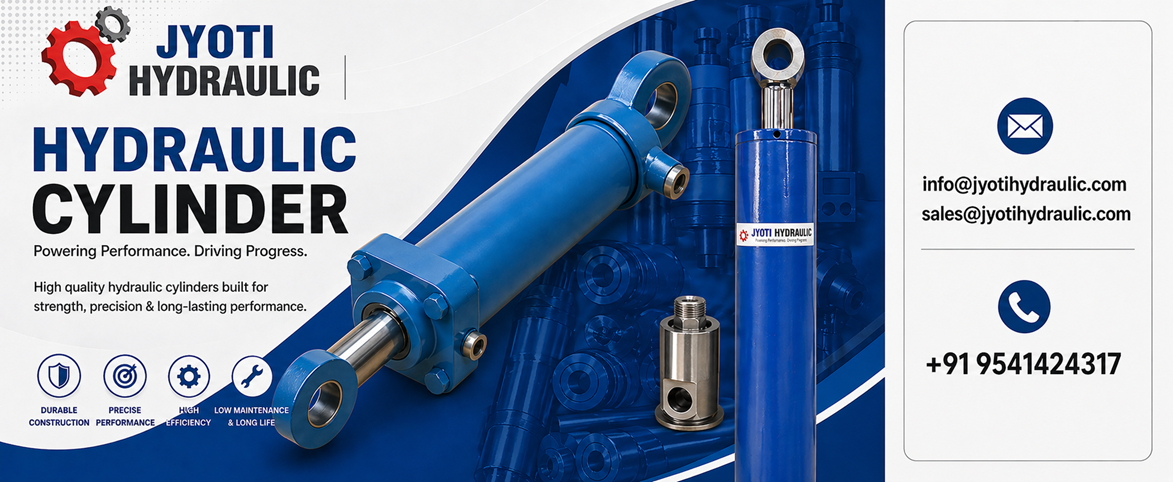
Jyoti Hydraulic is a trusted name for industries seeking durable, high-performance, and application-specific hydraulic cylinders designed to handle demanding working conditions. In modern industrial systems, hydraulic cylinders play a critical role in converting fluid power into linear mechanical force. From heavy-duty manufacturing lines to construction equipment, agricultural machinery, material handling systems, and steel plants, these components are essential wherever controlled movement, high force, and reliable performance are required.
India has become a strong hub for hydraulic technology due to rapid industrialization, infrastructure growth, automation adoption, and the expansion of sectors such as mining, agriculture, defense, railways, marine, and heavy engineering. As a result, the demand for a reliable Hydraulic Cylinder Manufacturer in India has grown significantly among businesses looking for quality, customization, cost efficiency, and long service life.
Whether you are comparing hydraulic cylinder prices, evaluating double acting models, or searching for specialized industrial solutions, understanding the technical aspects, applications, and selection criteria can help you make the right purchasing decision.
Industry Overview: Hydraulic Cylinder Manufacturing in India
The Indian hydraulic cylinder industry has evolved from basic fabrication to advanced precision engineering. Today, leading manufacturers use CNC machining, honed tubes, chrome-plated piston rods, high-grade seals, advanced welding, pressure testing, and customized design processes to deliver cylinders for critical applications.
India’s hydraulic cylinder market is driven by several major factors. Infrastructure development has increased the demand for construction equipment such as excavators, loaders, cranes, compactors, and concrete machinery. Manufacturing industries require cylinders for presses, lifting systems, clamping units, automation lines, and heavy-duty production equipment. Agriculture uses hydraulic cylinders in tractors, harvesters, trailers, balers, seeders, and other farm machinery.
Another important reason for growth is the rising preference for customized hydraulic systems. Many industries do not need standard cylinders; they require cylinders designed according to stroke length, bore size, mounting style, operating pressure, load capacity, duty cycle, speed, temperature, and environmental conditions. This is where experienced Industrial Hydraulic Cylinder Manufacturers in India add significant value by offering tailor-made engineering solutions instead of one-size-fits-all products.
Indian manufacturers are also becoming more competitive globally due to affordable production costs, skilled engineering talent, availability of raw materials, and improved quality standards. Many companies now serve both domestic and international customers with hydraulic cylinders built for performance, safety, and long-term reliability.
Technical Insights: How Hydraulic Cylinders Work
A hydraulic cylinder works on Pascal’s law, which states that pressure applied to a confined fluid is transmitted equally in all directions. In simple terms, pressurized hydraulic oil enters the cylinder chamber and pushes the piston. This piston movement creates linear force, allowing the cylinder rod to extend or retract.
The force generated by a hydraulic cylinder depends mainly on hydraulic pressure and piston area. A larger bore diameter produces higher force, while a longer stroke allows greater travel distance. This makes hydraulic cylinders ideal for applications where high force is required in a compact space.
A typical hydraulic cylinder includes several major components:
1. Cylinder Barrel
The barrel is the main body of the cylinder and houses the piston. It must be strong, accurately machined, and internally finished to allow smooth piston movement. Honed or skived tubes are commonly used for better surface finish and seal life.
2. Piston Rod
The piston rod transfers force from the piston to the machine component. It is usually made from high-strength steel and chrome-plated to resist corrosion, wear, and scoring. Rod quality is extremely important because poor surface finish can damage seals and reduce cylinder life.
3. Piston
The piston separates the internal chambers and moves under fluid pressure. It carries seals and wear rings to maintain pressure and reduce metal-to-metal contact.
4. Seals
Seals prevent hydraulic oil leakage and maintain pressure inside the cylinder. Common seal types include piston seals, rod seals, wiper seals, O-rings, and backup rings. The correct seal material depends on pressure, temperature, fluid type, speed, and working environment.
5. End Caps or Glands
These components close the cylinder ends and support the rod. They must withstand pressure loads and maintain proper alignment.
6. Ports
Hydraulic ports allow oil to enter and exit the cylinder. Port size and position influence flow rate, cylinder speed, and installation flexibility.
7. Mounting Arrangement
Mounting styles include clevis, flange, trunnion, foot, eye, lug, and customized mounting designs. The mounting method must match machine geometry and load direction.
Types of Hydraulic Cylinders
Different applications require different cylinder designs. Choosing the correct type is essential for efficiency, safety, and performance.
1. Single Acting Hydraulic Cylinder
A single acting cylinder uses hydraulic pressure in one direction only. The return movement happens through spring force, gravity, or external load. These cylinders are commonly used in lifting, jacking, pressing, and tipping applications where force is required in only one direction.
2. Double Acting Hydraulic Cylinder
A double acting cylinder uses hydraulic pressure for both extension and retraction. Oil enters one chamber to extend the rod and the opposite chamber to retract it. This design offers better control, faster operation, and greater versatility.
Businesses searching for Double Acting Hydraulic Cylinder Manufacturers in India usually need cylinders for applications requiring controlled movement in both directions, such as industrial automation, construction machinery, injection molding machines, hydraulic presses, and material handling equipment.
3. Telescopic Hydraulic Cylinder
Telescopic cylinders have multiple stages that extend one after another. They provide a long stroke from a compact retracted length. These are commonly used in dump trucks, tipping trailers, garbage compactors, and lifting platforms.
4. Tie Rod Hydraulic Cylinder
Tie rod cylinders use external rods to hold the end caps and barrel together. They are widely used in industrial machinery due to easy maintenance and cost-effective construction.
5. Welded Hydraulic Cylinder
Welded cylinders have a compact and robust design. The barrel is welded directly to the end caps or mounts, making them suitable for mobile equipment, construction machinery, agriculture, mining, and heavy-duty outdoor applications.
6. Mill Duty Hydraulic Cylinder
Mill duty cylinders are built for severe operating conditions. They are used in steel plants, rolling mills, foundries, forging units, and heavy engineering operations where shock loads, high temperatures, and continuous duty cycles are common.
7. Custom Hydraulic Cylinder
Custom cylinders are designed according to specific machine requirements. Bore size, stroke length, rod diameter, mounting style, pressure rating, seal material, and surface treatment can be customized to match application needs.
Hydraulic Cylinder Price in India
Hydraulic cylinder price in India depends on several technical and commercial factors. There is no single fixed price because each cylinder may differ in size, design, pressure rating, material, and application.
Key price-influencing factors include:
Bore Diameter
Larger bore cylinders require more material and machining, increasing the cost. Bore size also determines force output.
Stroke Length
Longer stroke cylinders need longer barrels and piston rods, which affects material cost and manufacturing complexity.
Working Pressure
High-pressure cylinders require stronger materials, better seals, precision machining, and stricter testing.
Cylinder Type
A simple single acting cylinder is generally less expensive than a double acting, telescopic, mill duty, or custom-designed cylinder.
Material Quality
High-grade steel, chrome-plated rods, seamless honed tubes, and premium seals increase initial cost but improve performance and life.
Mounting Design
Standard mounting styles are more economical, while customized mounts add design and fabrication costs.
Quantity
Bulk orders usually reduce per-unit cost due to production efficiency.
Application Severity
Cylinders used in mining, steel, marine, or heavy-duty applications require additional strength, coatings, and quality checks, which may increase pricing.
While price is important, choosing the lowest-cost option can lead to frequent breakdowns, oil leakage, downtime, seal failure, and machine damage. A reliable Hydraulic Cylinder Manufacturer in India focuses not only on affordability but also on performance, safety, durability, and lifecycle value.
Applications of Hydraulic Cylinders Across Industries
Hydraulic cylinders are used in a wide range of industries because they deliver high force, accurate movement, and rugged performance.
Construction Equipment
Excavators, loaders, bulldozers, graders, cranes, concrete pumps, and road construction machines depend on hydraulic cylinders for lifting, digging, pushing, steering, and positioning.
Agriculture Machinery
Tractors, harvesters, seed drills, balers, ploughs, tipping trailers, and sprayers use hydraulic cylinders for lifting, tilting, steering, and implement control.
Manufacturing and Automation
Hydraulic cylinders are used in assembly lines, presses, clamping systems, punching machines, bending machines, and automation equipment.
Steel and Metal Processing
Rolling mills, casting machines, forging presses, furnace doors, and material handling units require heavy-duty hydraulic cylinders that can handle extreme loads and high temperatures.
Material Handling
Forklifts, scissor lifts, dock levelers, stackers, cranes, and lifting platforms use cylinders for controlled vertical and horizontal movement.
Mining and Earthmoving
Mining machines operate in dusty, high-load, and abrasive environments. Hydraulic cylinders used here must be strong, sealed properly, and resistant to impact damage.
Marine and Offshore
Marine hydraulic cylinders are used in steering systems, hatch covers, deck machinery, cranes, and offshore equipment. Corrosion resistance is especially important in these applications.
Waste Management
Garbage compactors, balers, scrap presses, and recycling equipment use hydraulic cylinders to compress, lift, tilt, and push heavy loads.
Defense and Railways
Special-purpose hydraulic cylinders are used in defense vehicles, testing equipment, railway maintenance systems, lifting jacks, and positioning mechanisms.
Key Benefits of Hydraulic Cylinders
Hydraulic cylinders offer several advantages compared to mechanical or pneumatic systems.
High Force Output
Hydraulic systems can generate massive force from relatively compact components. This makes them ideal for heavy-duty applications.
Smooth and Controlled Movement
Hydraulic cylinders provide controlled extension and retraction, making them suitable for precision movement.
Durability
When properly designed and maintained, hydraulic cylinders can operate reliably for years in challenging environments.
Compact Design
Hydraulic cylinders deliver high power density, meaning they produce more force in less space.
Versatility
They can be designed in different sizes, mounting styles, pressure ratings, and configurations.
Easy Maintenance
Many hydraulic cylinders can be serviced by replacing seals, rods, bushings, or other wear parts.
Cost Efficiency
Although the initial investment may vary, a good-quality hydraulic cylinder reduces downtime, maintenance costs, and replacement frequency.
Buying Guide: How to Choose the Right Hydraulic Cylinder
Selecting the right hydraulic cylinder requires more than just checking price. A technically suitable cylinder improves machine performance and prevents premature failure.
1. Define the Load Requirement
Know the maximum force the cylinder must generate. This depends on hydraulic pressure and piston area.
2. Select the Correct Bore Size
Bore size determines pushing force. Oversized cylinders may waste energy, while undersized cylinders may fail under load.
3. Choose the Right Stroke Length
Stroke length should match the required movement. Extra-long strokes may require additional support to avoid rod bending.
4. Check Operating Pressure
The cylinder should be designed for the working pressure of your hydraulic system, with a suitable safety margin.
5. Evaluate Rod Diameter
Rod diameter affects pulling force, buckling resistance, and durability. Long-stroke cylinders often need larger rods.
6. Decide Between Single Acting and Double Acting
Use single acting cylinders for one-direction force applications. Choose double acting cylinders when controlled movement is required in both directions.
7. Consider Mounting Style
Incorrect mounting can create side loads, misalignment, and premature wear. Select clevis, flange, foot, trunnion, or custom mounting based on machine design.
8. Check Seal Compatibility
Seal material must match oil type, temperature, speed, and working environment. Poor seal selection causes leakage and pressure loss.
9. Consider Environmental Conditions
Dust, water, chemicals, high temperature, corrosion, and shock loads require special coatings, wipers, seals, and materials.
10. Choose an Experienced Manufacturer
Work with experienced Industrial Hydraulic Cylinder Manufacturers in India who understand design calculations, machining tolerances, seal technology, testing standards, and application-specific requirements.
Future Trends in Hydraulic Technology
Hydraulic technology continues to evolve with industrial automation, energy efficiency, and smart manufacturing.
Smart Hydraulic Cylinders
Sensors are increasingly being integrated into cylinders to monitor position, pressure, temperature, and performance. This supports predictive maintenance and reduces unexpected downtime.
Energy-Efficient Hydraulic Systems
Manufacturers are focusing on reducing energy loss through improved cylinder design, better sealing, optimized flow paths, and efficient hydraulic circuits.
Advanced Materials and Coatings
Improved rod coatings, corrosion-resistant materials, and wear-resistant surfaces are enhancing cylinder life in harsh conditions.
Compact High-Pressure Designs
Industries are demanding smaller cylinders capable of handling higher pressures without compromising safety.
Custom Engineering
The future belongs to application-specific hydraulic solutions. More businesses are choosing custom-designed cylinders instead of standard models.
Automation Integration
Hydraulic cylinders are increasingly used with PLCs, servo valves, proportional controls, and electronic feedback systems for precise movement control.
Sustainability and Leak Reduction
Leak-free design, longer seal life, recyclable materials, and efficient maintenance practices are becoming more important for environmentally responsible operations.
Why Choose a Reliable Hydraulic Cylinder Manufacturer in India?
A reliable manufacturer does more than supply a product. The right partner provides engineering support, application analysis, custom design, material selection, quality testing, and after-sales service.
A professional manufacturer should offer:
- Customized hydraulic cylinder design
- High-quality raw materials
- Precision machining
- Proper welding and assembly
- Premium sealing solutions
- Pressure testing
- Dimensional inspection
- On-time delivery
- Technical consultation
- Repair and replacement support
When you choose the right Hydraulic Cylinder Manufacturer in India, you get a product that improves machine productivity, reduces maintenance issues, and supports long-term operational success.
Conclusion
Hydraulic cylinders are essential components in modern industrial and mobile machinery. Their ability to generate high force, provide smooth motion, and operate under tough conditions makes them indispensable across construction, agriculture, manufacturing, mining, steel, marine, defense, and material handling industries.
India has emerged as a strong manufacturing base for hydraulic cylinders due to advanced engineering capabilities, cost-effective production, customization expertise, and growing industrial demand. Whether you need single acting, double acting, telescopic, welded, tie rod, mill duty, or custom hydraulic cylinders, choosing an experienced manufacturer is critical for performance and reliability.
For businesses looking for Double Acting Hydraulic Cylinder Manufacturers in India or trusted Industrial Hydraulic Cylinder Manufacturers in India, technical quality, application understanding, and service support should be just as important as price.
FAQ Section
1. What is a hydraulic cylinder?
A hydraulic cylinder is a mechanical actuator that converts hydraulic fluid pressure into linear force and motion. It is commonly used for lifting, pushing, pulling, pressing, clamping, and positioning heavy loads.
2. Who is the best hydraulic cylinder manufacturer in India?
The best manufacturer is one that offers quality materials, precision manufacturing, custom design, pressure testing, technical support, and reliable after-sales service. Jyoti Hydraulic provides industry-focused hydraulic cylinder solutions for a wide range of applications.
3. What is the difference between single acting and double acting hydraulic cylinders?
A single acting hydraulic cylinder applies force in one direction and returns through spring, gravity, or external force. A double acting hydraulic cylinder uses hydraulic pressure for both extension and retraction, offering better control and versatility.
4. Where are double acting hydraulic cylinders used?
Double acting hydraulic cylinders are used in hydraulic presses, construction machinery, automation systems, agricultural equipment, material handling machines, steel plants, and industrial production equipment.
5. What factors affect hydraulic cylinder price in India?
Price depends on bore size, stroke length, rod diameter, working pressure, material quality, seal type, mounting style, cylinder design, quantity, and application requirements.
6. Can hydraulic cylinders be customized?
Yes. Hydraulic cylinders can be customized based on bore, stroke, rod size, pressure rating, mounting style, seal material, operating speed, temperature range, and industry-specific needs.
7. How do I choose the right hydraulic cylinder?
You should consider load capacity, stroke length, operating pressure, bore size, rod diameter, mounting arrangement, environmental conditions, seal compatibility, and duty cycle before selecting a cylinder.
8. What are common causes of hydraulic cylinder failure?
Common causes include seal wear, rod damage, oil contamination, misalignment, side loading, excessive pressure, poor lubrication, corrosion, and improper installation.
9. How can hydraulic cylinder life be increased?
Use clean hydraulic oil, maintain correct pressure, prevent side loads, inspect seals regularly, protect the rod surface, avoid overloading, and follow proper maintenance schedules.
10. Which industries use industrial hydraulic cylinders?
Industrial hydraulic cylinders are used in manufacturing, steel, mining, agriculture, construction, marine, railways, defense, material handling, recycling, and heavy engineering sectors.
Contact Jyoti Hydraulic for Expert Hydraulic Cylinder Solutions
Looking for a reliable Hydraulic Cylinder Manufacturer in India for your industrial or mobile machinery needs? Jyoti Hydraulic offers high-quality, durable, and customized hydraulic cylinders designed for demanding applications.
For product inquiries, technical guidance, custom requirements, or pricing details, get in touch today.
📧 Email: info@jyotihydraulic.com
📞 Phone: +91 9541424317
Request a quotation now and get expert consultation from Jyoti Hydraulic for the right hydraulic cylinder solution for your application.


